
Every Monday we will compare how Jimmer stacks up with the other rookie PGs that were taken in the first round. Here are how they all did in their debuts:

Every Monday we will compare how Jimmer stacks up with the other rookie PGs that were taken in the first round. Here are how they all did in their debuts:
Now that we have an idea of what Jimmer can accomplish it’s time to set some goals:
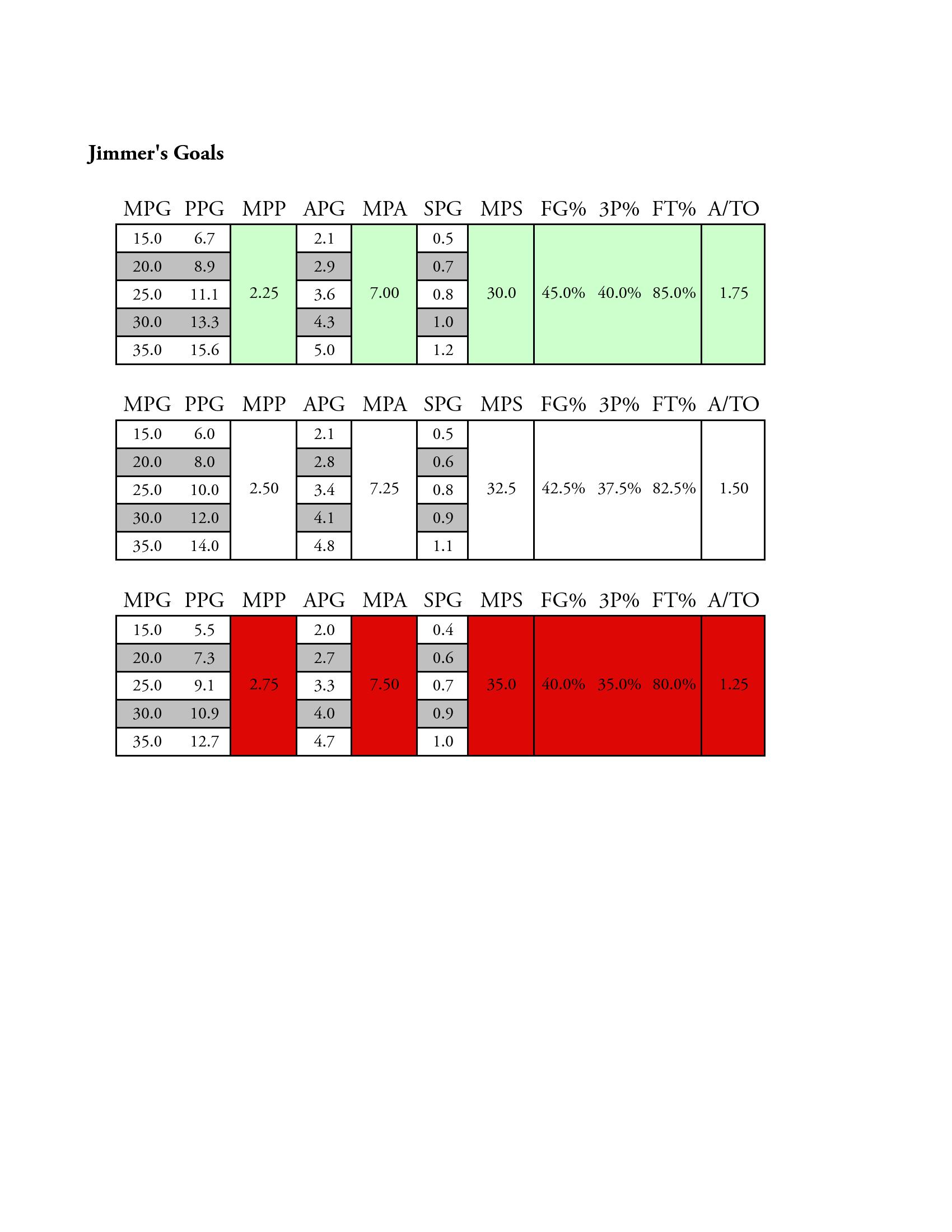
Our goal for Jimmer is to score a point every 2.25 minutes, assist on a basket every 7.00 minutes, create a turnover every 30.00 minutes while shooting 45.0-40.0-85.0% from the field, three-point line, and free-throw line. We also have a goal for him to have an assist to turnover ratio just below two at 1.75.
(If you click the image above you will see the color scheme that will be used in the box scores: green = met or exceeded goal, white = did not meet goal, red = grossly below goal. You can also see what Jimmer’s averages will be depending on how many minutes he plays.)
We project that Jimmer will score the ball not quite as well as Curry but better than Billups. His minutes per assist goal is more in line with Billups’ rookie year than Curry’s or Nash’s and we hope that his minutes per steal will be slightly better than Steve’s.
Where we expect him to perform better than the combined averages of Billups, Curry, and Nash is from the field. His numbers will be similar to Curry’s (46.2-43.7-88.5) and better than the averages (42.0-39.5-85.3).
The image below will show you how our goals line up with ESPN’s fantasy projection for Jimmer (just stumbled upon this setting up my fantasy basketball team. We came to a very similar conclusion as ESPN did), the rookie seasons and the first 30+ minute seasons of our buddies Billups, Curry and Nash.
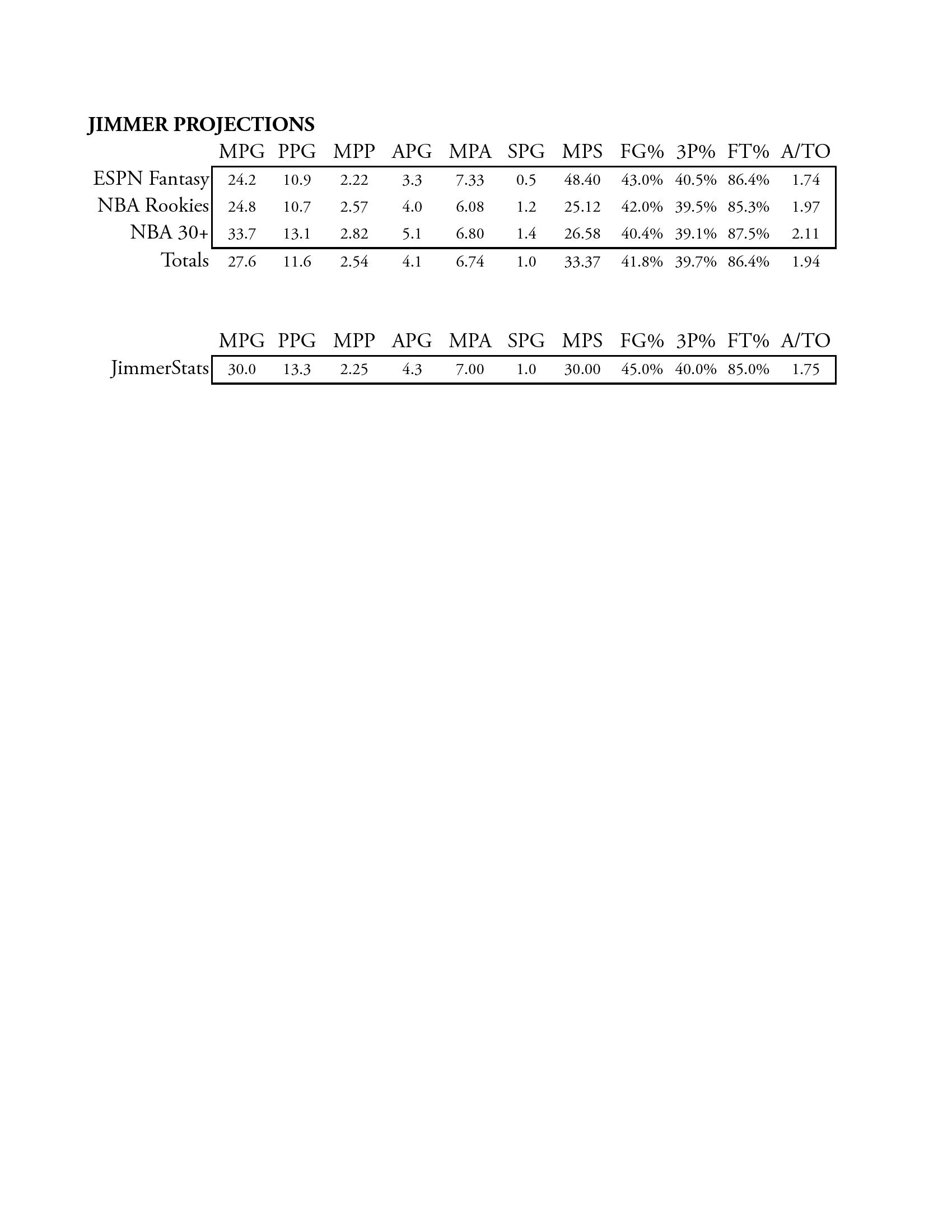
As you can see we project that Jimmer will meet these goals and average 30.0 mpg, 13.3 ppg, 4.3 apg, 1.0 spg, 1.75 a/to ratio and shoot 45.0-40.0-85.0%. Each box score will reflect if he has met these goals and our season stats will keep track of his progress.
In part 1 of our Projecting Jimmer series we looked back at the college careers of NBA players that we think Jimmer could play like this year.
In part 2 we will look at those same three NBA players – Chauncey Billups, Stephen Curry, Steve Nash – and their NBA careers to project how Jimmer will stack up.
Jimmer’s college numbers were very comparable to these three players and we will use the following categories from their NBA careers to project Jimmer: rookie season, first 30+ minutes per game season, best season and career stats. The main emphasis will be on the first two categories as those are the most similar to Jimmer’s current situation.

All three of these players played varying minutes their rookie campaigns which is why we will focus on “minutes per” instead of per game averages. It is unclear as to whether Jimmer will play 15, 25 or 35 minutes per game this season but when breaking the stats down to a “minutes per” basis, it doesn’t matter.
These three players combined to average a point every 2.57 minutes, an assist every 6.08 minutes and a steal every 25.12 minutes. They also combined to shoot 42.0% from the field, 39.5% from three, 85.3% from the free-throw line and had a 1.97 assist to turnover ratio.
Does it seem out of the realm of possibility for Jimmer to average 24.8 mpg, 10.7 ppg 4.0 apg, 1.2 spg while shooting the above percentages? Not at all. In fact, JimmerStats projects that he will surpass some of those numbers.

We project that Jimmer will finish the season playing 30 minutes per game. He played 26 in his first game last night against the Lakers and he is one injury away from having to play a larger role. That role will most likely increase regardless of injury as he gains valuable experience and becomes more comfortable running the offense.
Steve Nash only played 10.5 mpg his rookie season while Chauncey played 27.7. To compare how they did when they were both given over 30 minutes per game (where we project Jimmer to end up) we’ve added the above graph.
As the minutes went up, the production went down: minutes per point, assist and steal increased and in fact, the only two categories that improved were the players combined free-throw percentages and their assist to turnover ratio. Jimmer seems ready and prepared to play effectively in bursts this season but can he keep up that effectiveness over longer stints? We may have the answer to that if his playing time plays out like we think.

Can you see Jimmer averaging 18 and 8 a few years down the road while shooting 48-43-91? We don’t think it will happen this year but it also cannot be ruled out.

Not only is it interesting to look at these stats in this format but it is also beneficial to our discussion of how to project Jimmer. Now that we have a foundation of similar players’ stats to look out, we can more adequately set goals for Jimmer and project how his rookie year will play out.
What will Jimmer Fredette’s NBA career be like?
Will his frame enable him to become a big, scoring point guard like Chauncey Billups?
Will his shooting ability allow him to emulate Steve Nash’s success and become a premier point guard?
Will his college success translate to the NBA immediately a la Stephen Curry in 2009-2010?
It is almost impossible to project the future NBA careers of any rookie in the league, but with Jimmer it is even more difficult. He could be out of the league faster than you can say Rafael Araujo, he could become a bigger, better Eddie House, or he could transform into an all-star point guard.
There is much to speculate and many differing opinions but as I contemplated this question, I immediately began to think of players that either reminded me of Jimmer, or that Jimmer could ultimately become like.
The three players that came to mind most are mentioned above: Chauncey Billups, Steve Nash, and Stephen Curry.
Why these three?
Chauncey’s size (6’3” 210) and his playing style have always reminded me of Jimmer. Jimmer (6’2” 195) is built much like Chauncey is and his style of play, score first, reminds me of Chauncey as well. While they both are more than sufficient at creating for others, it isn’t always the first thing on their minds. Although Jimmer is not as athletic as Chauncey was coming out of college, the ability to hit the big shot and ice the game at the free throw line will allow Jimmer to play minutes late in tight games.
Jimmer is not currently the playmaker that Steve Nash is but his shooting ability seems to be on par with the two-time MVP. Steve (6’3” 178) doesn’t have the same build as Jimmer or Billups but he is tall for a PG and this allows him to get his shot off in difficult places. We will look at the numbers in more detail later on but Nash proves that someone with similar defensive liabilities can find a place in the league if they can excel on the offensive end of the court.
Stephen Curry (6’3” 185) is also a player that Jimmer should emulate. Their stats from college are very similar; especially Steph’s freshmen and sophomore years where he was not asked to make as many plays for others. Stephen was an elite college scorer and proved that he could get his shot off in the NBA. Jimmer should be able to prove that he can get his shot off as well with his quick elevation and release. Jimmer may not be as creative as Steph is passing the ball but I don’t see why he can’t have the Curry-like success scoring the ball his rookie year.
Before we look as those three players’ NBA numbers, let’s take a look back at their college numbers and compare them to Jimmer:
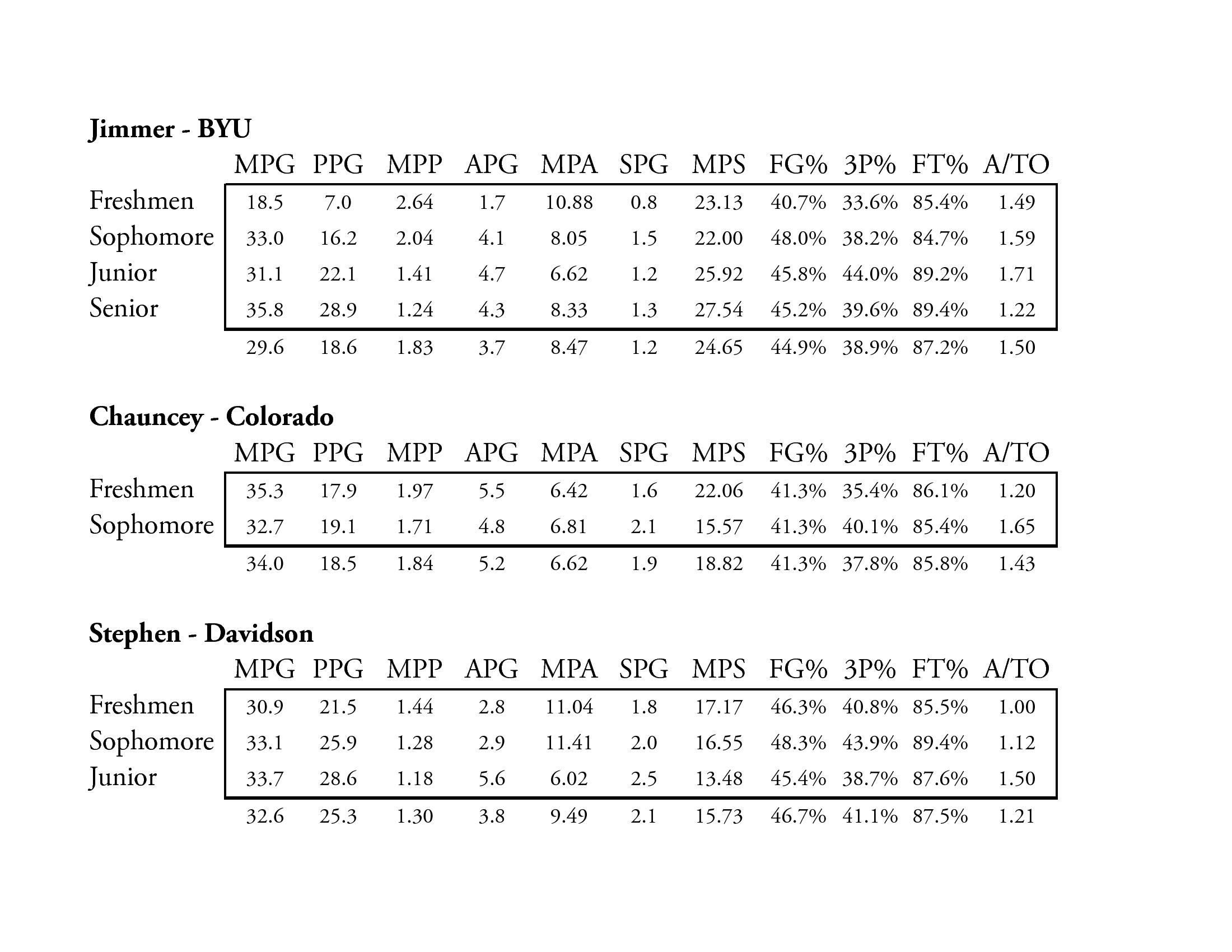

Jimmer and Chauncey’s career Minutes per Point are almost identical. They both scored a point every 1.8 minutes (or 1 minute 48 seconds). In Jimmer’s last two seasons he scored the ball at an even higher rate than Chauncey did. Chauncey proved to be more of a playmaker than Jimmer but if you compare Jimmer’s junior year, when he wasn’t asked to shoot every time down, his 6.62 Minutes per Assist are identical to Chauncey’s career MPA numbers. Jimmer also was able to shoot the ball better than Billups from the field, the three-point line and the free throw line. Chauncey’s numbers at Colorado were very similar to Jimmer’s at BYU.

Both Jimmer and Steve played four seasons in college at smaller schools so there numbers are the most comparable. Not surprisingly Jimmer scored the ball more frequently than Steve did while Nash was setting up his teammates more than Jimmer was. Their minutes per steal both come in at one steal per 24 minutes played which also is no surprise, as defense is not a strength for each of these players. Jimmer shot the ball slightly better from the field, slight worse from three, and slightly better from the free throw line but the differences are negligible.
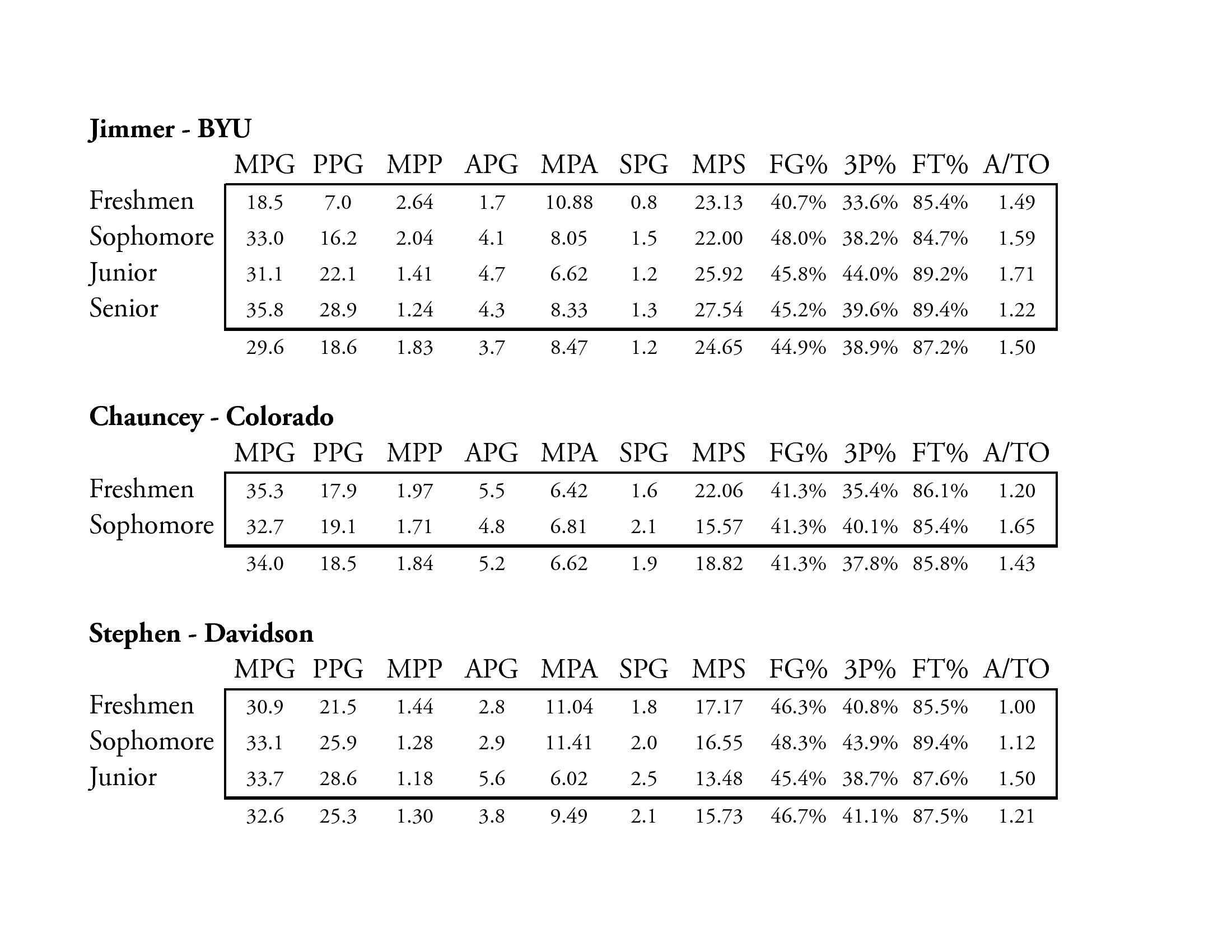
Stephen and Jimmer both lit it up in the college ranks. When you compare their last college seasons you could easily argue that Stephen had a better year. He scored more frequently (every 1.18 minutes to Jimmer’s 1.24), assisted more often (6.02 to 8.33), created more turnovers (steal every 13.48 minutes to Jimmer’s 27.54) and had a higher assist to turnover ratio (1.50 to 1.22). They almost shot identical percentages from the field and Jimmer barely outshot Steph from the three-point line and the free throw line. Even though Curry had a slight edge in most of the categories the similarities in their seasons are certainly evident. NBA scouts were highly critical of both players throughout their college days but they still ended up in the lottery.
Overall, Jimmer’s college numbers stack up well with Chauncey, Steve and Stephen; even surpassing them in certain categories. Now, are a player’s college stats a clear indicator of how they will play in the NBA? Of course not, but it is something that will help us make a more informed speculation when we attempt to project Jimmer’s future.
Check back in when we analyze how the NBA careers of these three players can help us paint a more clear picture of who Jimmer might become and what types of goals he should shoot for.
 JimmerStats